Homeowner guide
Common spiders in Ontario, and how to tell what is on your house
Most of the spiders you will ever see in Ontario belong to about fifteen kinds, and almost all of them are harmless. This guide sorts spiders in Ontario the way a homeowner meets them: the ones that build on the outside of the house, the ones that stay in the garden, the ones that live indoors, and the few that can actually bite. It is written for the homes along Lake Huron from Sarnia to Port Elgin, where the lake insect hatch makes spider season among the heaviest in the province, but it holds for most of southern Ontario.

The ones that build on your house
These are the spiders Spider Pros is called about. They live on the outside of the building because the lights draw the insects they eat.
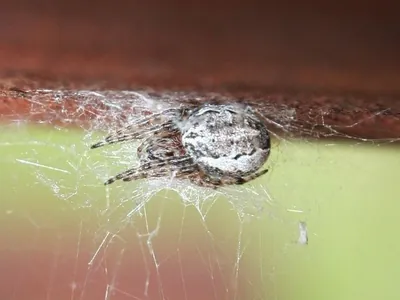
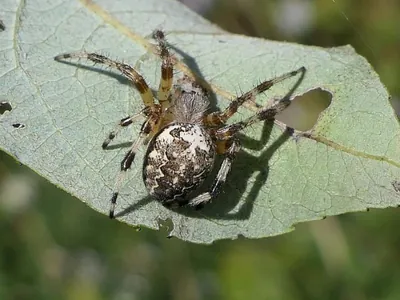
Larinioides sclopetarius, sometimes called the bridge spider, or the grey cross spider in European guides
The lakeside spider. Grey brown, about 1 cm body, banded legs, a pale cross shaped mark on the back, often dozens in a row under eaves, on railings and on any siding that is lit at night. It repairs or rebuilds its round web at dusk, sits in the hub after dark and tucks into a gap or corner by day. On the building from late May, heaviest July to September. On lit buildings within sight of the lake it is usually the main source of the webs and the dark spotting (spider droppings) on light siding, with the furrow orb weaver and the common house spider adding to it.
Bite: not a concern. It runs rather than bites.
Parasteatoda tepidariorum
Small, round bodied, mottled brown, 5 to 8 mm, with a tall rounded abdomen and thin banded legs. Builds the messy tangled cobwebs in porch ceilings, window corners, under deck rails, in garages and behind shutters, and leaves old webs full of debris and small brown papery egg sacs hanging in the web. Several generations overlap, so new webs appear within days of old ones being cleared. Active all season outdoors and all year indoors, and with the bridge orb weaver it accounts for most of the webbing we vacuum off a house.
Bite: very rare and mild.
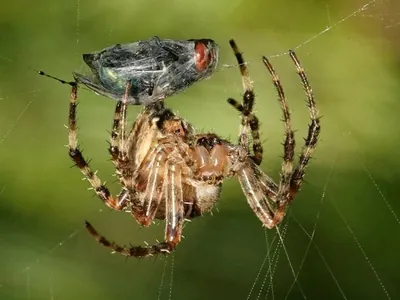
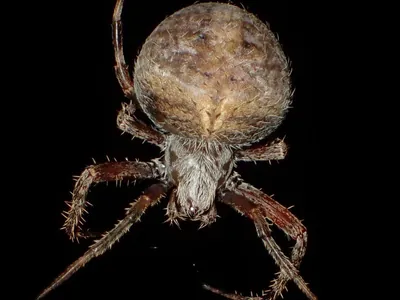
Araneus diadematus, also called the European garden spider
The big wheel web across a doorway, between a porch post and the eaves, or over a window in late summer. Fat bodied, 1 to 2 cm, brown or orange with a row of white dots forming a cross on the back, and alarming in September because it has been growing all summer. A European species now common across southern Ontario. It sits head down in the hub of the web by day, which makes it the easiest orb weaver to photograph and identify.
Bite: only if squeezed, mild and local.
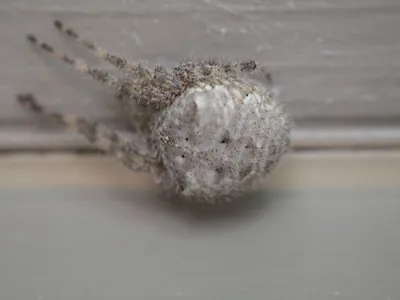
Araneus cavaticus, the barn spider
The spider from Charlotte's Web. Large, up to 2 cm, plain hairy brown or grey with a darker pattern on the abdomen, and the one that builds the big web on the porch light, the garage door frame or the eaves of a barn or cottage in August and September. Unlike the cross orb weaver it hides in a crack, under a rail or in a soffit gap by day and sits in the web after dark, so people see the web every morning and rarely the spider.
Bite: only if squeezed, mild and local.
Neoscona crucifera
The other large brown orb weaver on houses in late summer, 1 to 2 cm, hairy, with a mottled or spotted abdomen and banded legs. Easily confused with the barn orb weaver and found in the same places, under eaves, around porch lights and between shrubs and the wall. It builds a fresh web most evenings and takes much of it down at dawn, then rests in a curled leaf or a gap in the trim. Most common from August to the first hard frost.
Bite: only if squeezed, mild and local.
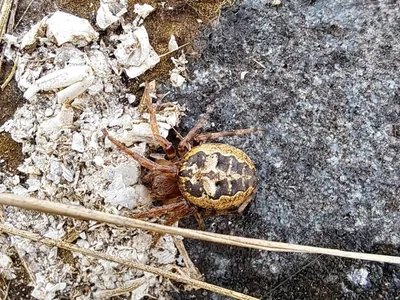
Larinioides cornutus
A close cousin of the bridge orb weaver and often mixed in with it, 6 to 14 mm, found on docks, railings, boathouses and the lake side of homes, and along rivers and marshes. The tell is a dark leaf shaped mark with a scalloped edge down the back, usually on a pale grey or tan abdomen. It hides in a silk retreat in a corner or under a rail by day and sits in its web at night, and is one of the few orb weavers that stays active in cool weather, so it is on buildings from April to November.
Bite: not a concern.
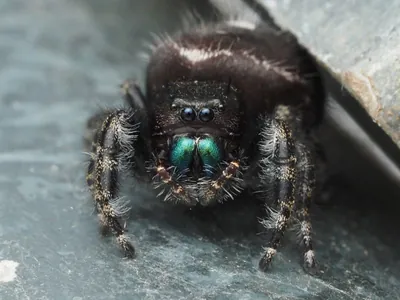
Phidippus audax
Black, chunky, about 1 cm, with white spots on the abdomen and iridescent green mouthparts. It sits on sunny siding, deck rails and window frames, moves in short jumps and turns to watch you, which is why people notice it. No web; it hunts by sight and spins a small silk shelter under trim or in a shutter to sleep in. Active from the first warm days of May into October.
Bite: only if trapped against skin, mild.
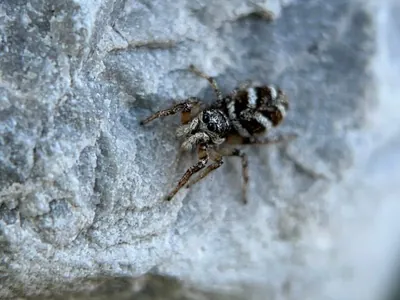
Salticus scenicus
The small black and white striped jumping spider, 5 to 7 mm, on sunny brick, window sills, stone steps and fence posts from May on. It stalks flies and moves in quick hops, and often comes inside on a sunny window. No web. Harmless and useful, and not something Spider Pros treats for.
Bite: only if trapped against skin, mild.
Philodromus
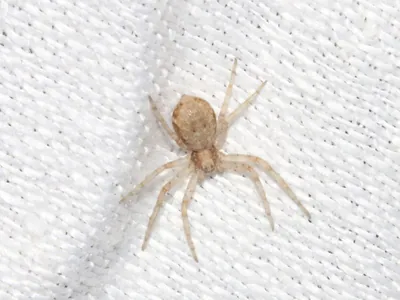
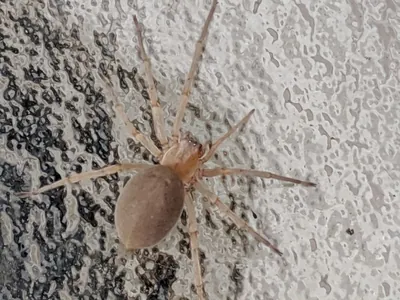
Flat, grey brown or mottled, 5 to 8 mm, with legs held out to the sides like a crab. These are the quick small spiders that dart sideways across sunny siding, fence boards and window frames and freeze when you look at them, and they sometimes come inside through the window track. No web; they hunt by sight and shelter under bark, siding laps and trim. Common from spring to fall and often mistaken for a young wolf spider.
Bite: not a concern.
Agelenopsis
The flat sheet webs with a funnel at one end on the lawn, in the foundation plantings and along the bottom course of siding, obvious on dewy September mornings. Striped brown, fast, with long spinnerets sticking out the back, which is the quick tell. Rarely in the open, except for wandering males in September.
Bite: very rare, mild.
Dolomedes tenebrosus
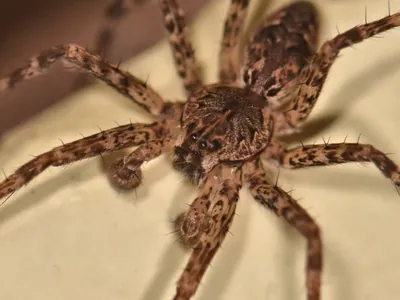
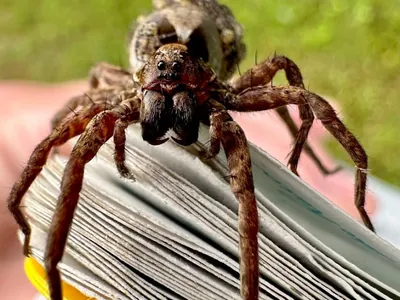
The one that causes the alarm on the lake. Mottled brown with dark banded legs, up to about 9 cm across in a big female, on dock posts, boathouse walls, tree trunks and the lake side of cottages, sometimes well away from water and sometimes indoors. A hunter, not a web builder, and shy. Usually reported to us as a wolf spider. Its cousin the six spotted fishing spider (Dolomedes triton), greenish brown with a white side stripe, lives on the water surface and dock edges and rarely comes onto buildings.
Bite: only if squeezed, brief local pain like a bee sting, no lasting effect.
The ones that stay in the garden
Leave these. They are not on the house and they eat a lot of what is.
Black and yellow garden spider
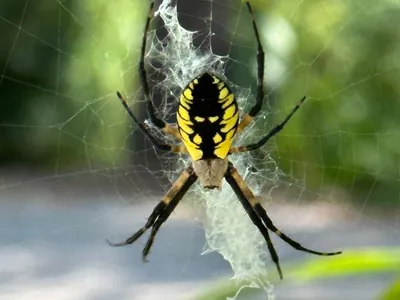
Argiope aurantia, and its striped cousin the banded garden spider, Argiope trifasciata
The big striking one with the thick white zigzag in its web among the tomatoes, the hydrangeas or the tall grass in August, up to 2.5 cm body, black with bright yellow markings. It sits head down in the centre of the web all day and does not move far all season, then leaves a brown papery egg sac the size of a grape in the plants in fall. The banded garden spider is slimmer, striped in yellow, white and black, and common in the dune grass and along the lakeshore. Both stay in the garden and are almost never on the house.
Bite: not a concern.
Flower crab spiders
Misumena and relatives
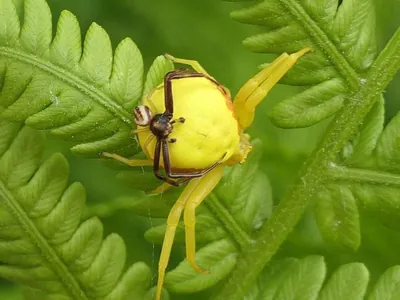
Small, 4 to 10 mm, with the front two pairs of legs long and held out like a crab. They sit in flowers, often white or yellow to match the petals, and ambush bees and flies that land. The goldenrod crab spider can slowly change colour between white and yellow over several days. They stay in the garden and the goldenrod along the ditch and are not a house spider.
Bite: not a concern.
Marbled and shamrock orb weavers
Araneus marmoreus, Araneus trifolium
The pumpkin orange marbled orb weaver and the pale shamrock orb weaver build big webs in shrubs and tall grass in September and October and hide in a curled leaf. The marbled one is the October identification question. Rarely on the house.
Bite: not a concern.
Lycosidae
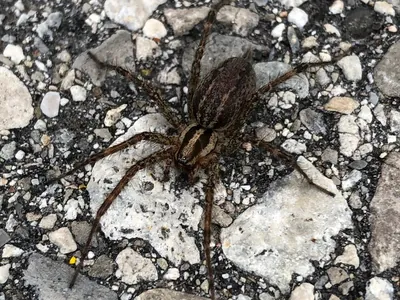
Ground hunters, brown and hairy, 0.5 to 2.5 cm, under mulch, stones and the deck. The female carries her egg sac behind her and then her spiderlings on her back. They come indoors through door sweeps in September. The old reports of flesh destroying wolf spider bites came from South America and have been discredited.
Bite: only if squeezed, brief local pain like a bee sting, no lasting effect.
The ones you meet indoors
Some live inside year round; others wander in through door sweeps and window tracks in the fall.
Long bodied cellar spider
Pholcus phalangioides
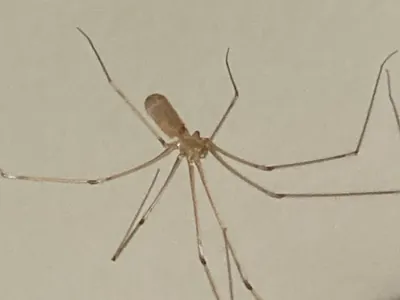
The long legged "daddy longlegs" living year round in the basement, garage and crawl space, hanging upside down in a loose web. The story that it is the most venomous spider but cannot bite you is false on both counts: it can bite, barely, and the effect is a brief tingle. The name daddy longlegs is also used for harvestmen, which are not spiders and have no venom at all, and for crane flies, which are flies.
Bite: not a concern.
Tegenaria domestica
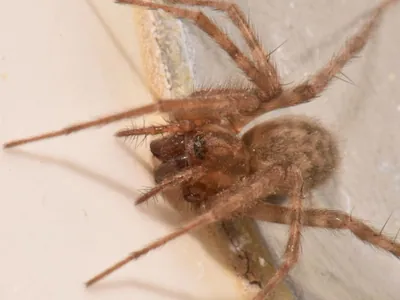
The big brown basement spider. Striped head, long legs, 1 cm body, in a flat sheet web with a funnel in basement corners, window wells, garages and crawl spaces, year round. This is the spider people report as a hobo spider or giant house spider. The hobo spider does not occur in Ontario, and health agencies have dropped its bite reputation anyway.
Bite: not a concern.
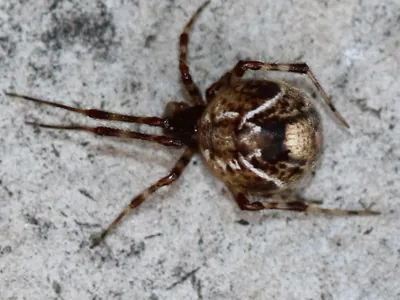
Steatoda borealis, Steatoda triangulosa
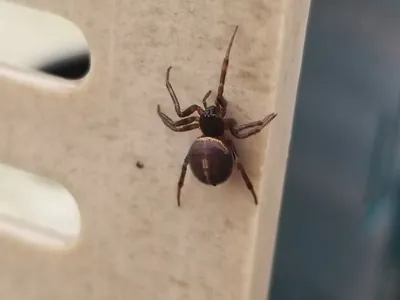
The usual black widow false alarm. Glossy dark brown to black, 4 to 10 mm, round bodied, in a tangled web under siding trim, in window wells, garages and basements. The northern false widow has a pale line along the front of the abdomen; the triangulate cobweb spider has a zigzag of cream triangles down the back. No hourglass.
Bite: rare, a sharp local sting that fades in a day.
Cheiracanthium mildei indoors; the native Cheiracanthium inclusum is mostly outdoors
Pale yellow or greenish, 6 to 9 mm, no web, hides by day in a small silk sac in the top corner of a room or behind a picture and hunts at night. Of the spiders found in Ontario homes this is the one most often confirmed as a biter, usually when trapped in bedding or clothing. The bite is a sharp sting that reddens and itches for a few days. Claims online that it rots the skin come from old case reports and have not held up: in verified bites no tissue damage has been found.
Bite: possible, mild, the one worth knowing by sight.
Eastern parson spider
Herpyllus ecclesiasticus
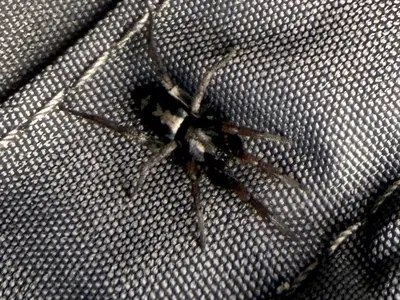
Black and grey with a white cravat shaped mark down the back, 1 to 2 cm, named for the old fashioned clerical collar the mark resembles. A fast night hunter that spends the day in a silk sac under bark, stones or the siding, and wanders indoors in fall, turning up in sinks, bathtubs, bedding and under clothes left on the floor. No web. Bites usually happen when someone rolls onto one in bed or pulls on clothing it is hiding in.
Bite: sharp, local, no lasting effect.
Woodlouse spider
Dysdera crocata
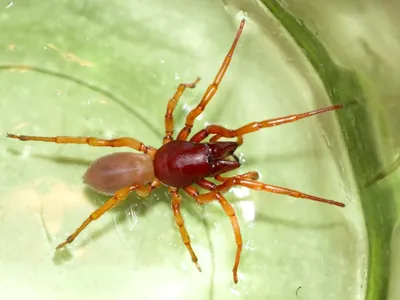
Red orange head and legs, a dull tan or cream abdomen, and long forward pointing jaws that look out of proportion, 9 to 15 mm. Found under flowerpots, stones, mulch and the bottom step, wherever woodlice (sow bugs and pill bugs) live, because that is nearly all it eats, and sometimes in a damp basement or crawl space. Slow moving by day and often mistaken for something dangerous because of the colour and jaws.
Bite: can pinch if handled, no lasting effect.
The one Ontario spider that matters medically, and the one that is a myth
Latrodectus variolus
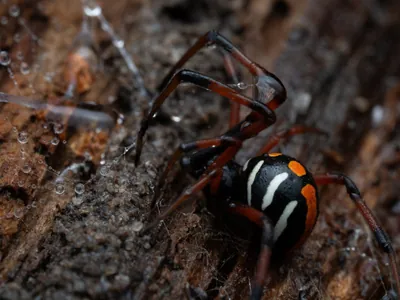
Found in pockets across southern Ontario, mostly the Lake Erie sand country and oak savanna, with confirmed records in the Pinery and Grand Bend dune area in Lambton County and scattered finds further north. It likes dry, undisturbed cover: woodpiles, stone walls, stumps, the underside of furniture left out all winter. Glossy black with a red hourglass on the underside that is split into two triangles that do not touch, and usually a row of red spots down the top of the abdomen. Males and juveniles are smaller, striped brown, white and red, and rarely recognized. The black widows most Ontarians actually encounter are western black widows arriving in grape bunches from California and Mexico, with an unbroken hourglass.
Bites are rare. The spider is shy and bites only when pressed against skin. If you think you have one, photograph it from a distance and call us.
Bite: the only Ontario spider whose venom can make you ill. Symptoms are pain spreading from the bite, muscle cramping, sweating and nausea over a few hours; it is very rarely life threatening and treatment is supportive. If you think you were bitten, call the Ontario Poison Centre at 1-800-268-9017 or go to emergency, and bring a photo of the spider if you can.
Brown recluse
Loxosceles reclusa
Not established in Ontario. Isolated specimens have arrived in shipped goods, but there is no population here, and the "recluse bite" diagnosed in this province is almost always a skin infection or another cause. A company offering brown recluse control in Ontario is treating a spider that does not live here.
Not a concern in Ontario.
What a spider bite actually looks like. A small red bump, sometimes two tiny marks, itchy for a day or two. Wash it, ice it, leave it alone. Most "spider bites" are never confirmed; studies that checked found the cause was usually an infection, another insect or unknown. A real spider bite is rarely seen happening, and you will often have the spider. Spreading redness, fever or a wound that worsens over days is a reason to see a doctor, and it is usually not a spider.
Quick identification table
| Where you saw it | Web | Looks like | Most likely | Bite |
|---|
| Under eaves, on lit siding, in rows | Round web, used night after night | Grey brown, 1 cm, pale cross | Bridge orb weaver | No concern |
| Porch ceiling, window corner, garage | Messy tangle with debris | Small, round, mottled | Common house spider | Very rare |
| Across a doorway in September | Big wheel web | Fat, brown, sometimes a white cross | Cross, barn or spotted orb weaver | Mild if squeezed |
| Sunny siding, no web, watches you | None | Black, chunky, white spots | Bold jumping spider | Mild if trapped |
| Sunny siding, darts sideways | None | Flat, grey brown, small | Running crab spider | No concern |
| Lawn and foundation, dewy sheet | Flat sheet with funnel | Striped, fast, long spinnerets | Grass spider | Very rare |
| Dock, boathouse, lake side wall | None | Huge, mottled brown, banded legs | Dark fishing spider | Rare, like a sting |
| Basement, hanging upside down | Loose tangle | Tiny body, very long legs | Cellar spider | No concern |
| Basement corner, window well | Flat sheet with funnel | Big, brown, striped head | Barn funnel weaver | No concern |
| Under trim, garage, looks like a widow | Tangle | Glossy dark, no hourglass | False black widow | Rare, mild |
| Bedroom wall near ceiling | Small silk sac | Pale yellow, 6 to 9 mm | Yellow sac spider | Possible, mild |
| Woodpile, patio furniture underside | Irregular, strong | Glossy black, split red hourglass underneath | Northern black widow | Poison Centre or emergency |
What this means for your house
The spiders that make a house look neglected are the first group, and every one of them is there for the same reason: the insects coming to the lights. That is why Spider Pros starts every visit by removing the webs, spiders and egg sacs rather than spraying, and why a warmer bulb and a motion sensor on the porch light do more over a summer than most products. If you are not sure what you have, send us a photo with your booking and we will tell you.
Book my visit
Species photographs are by Ontario naturalists on iNaturalist, used under Creative Commons licences (CC0, CC BY and CC BY-SA) with credit and a link to each observation. We will add our own photos from customer homes as the season goes on.
Related guides: Spider web removal versus spraying, The spider life cycle and why timing matters, When is spider season along Lake Huron.