Homeowner guide
A lot of spider control companies arrive with a sprayer and leave. The webs are still on the house when they drive away. The question of spider web removal vs spraying is really a question about what you want fixed: the way the house looks today, the spiders that keep rebuilding, or both. Here is what each method does, what it does not do, and why Spider Pros always starts with the vacuum.
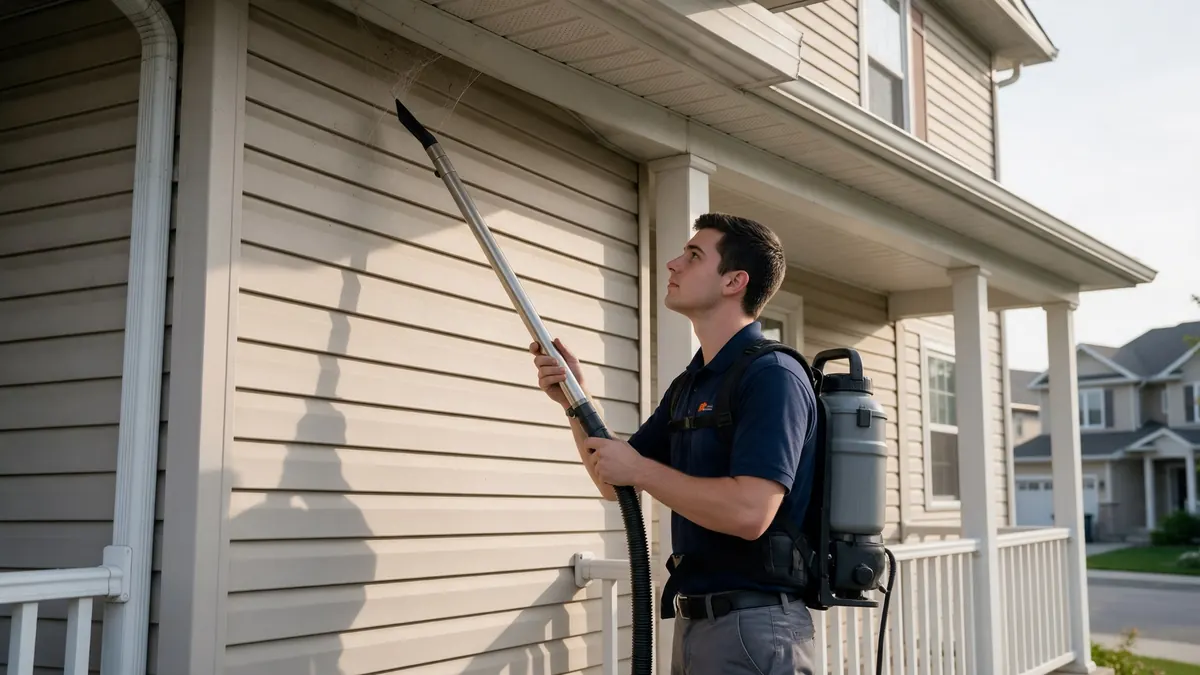
Removal is physical. A backpack HEPA vacuum takes the web, the spider in it and the egg sac tucked behind it off the house in one pass. It covers everything within reach: porch ceilings, lights, window and door frames, the garage door frame, first floor soffits and the foundation line. High eaves and the peaks on a two storey home are swept down with a cobweb brush on a telescoping pole. When the technician walks away, the house is clean, and nothing was applied to achieve that.
The egg sacs are the part people underestimate. Each one holds dozens of spiderlings that hatch straight into the same sheltered corner. A web knocked off with a broom and the sac left behind is a house that gets worse by August. Taking the sac matters more than taking the web.
Removal does not leave anything behind to stop the next spider arriving, and we will not pretend otherwise. The light is still there and so is the sheltered frame. But removal starts the clock at zero every time, it works instantly, and rain does not wash it off. For most of the house, most of the season, that is enough.
A residual product applied to a surface stays active on that surface for a period of time, and a spider that crosses it is affected. That is useful on a corner that refills week after week no matter how often the web comes down. On that corner, a treatment is the honest next step.
Here is what spraying does not do. It does not remove the web; a sprayed web is a grey, dead web still hanging across your window. It does not remove the egg sac, whose contents are protected inside the silk. It does not hold on a deck board or railing in the sun for more than a few days. And it is not needed on the wall of a house where no spider is living.
That last point is the one the industry would rather you did not think about. Product on every wall of every house every month, year after year, does two things. It is far more product than the job needs, around far more people, pets and pollinators than the job needs. And it puts far more of it around your dog, your garden, the bees in the lavender and the lake at the end of the road than the job ever required.
Visible result today: removal clears the house on the spot; spraying leaves the webs in place. Egg sacs: removal takes them; spraying does not reach them. Rain: removal is unaffected; a treatment on an exposed surface is worn down by weather and sun. Lasting effect on a corner that refills: removal alone will need repeating; a targeted treatment on that corner holds. Exposure for people, pets and pollinators: none from removal; some from any treatment, which is why it belongs only where it is earned. Best use: removal everywhere, every visit; treatment on the small number of sites where activity justifies it.
After removal, the technician knows the house. The corners that were thick with webs and sacs, the light with six spiders behind it, the gap at the top of the garage door that was clearly a nursery: those sites justify a treatment. The product is registered in Canada and applied only to the sites the label allows, at the lowest label rate that works. The technician works supervised by our licensed exterminator and wears what the label requires: long sleeves, long pants, chemical resistant gloves, and eye protection for overhead work, plus a respirator for overhead work as company policy. Applications wait for still conditions; nobody sprays into a gust off the lake.
People and pets stay off treated areas until they are dry, and the time is written down. After every visit you get a written summary of what was used, where, and when each area is clear. If you read it and the list of treated sites is short, that is the point.
A wall with two small webs and no sacs does not need product. A porch light that had one spider behind it does not need product. The soffit on the sunny side with nothing on it does not need product. A deck or a railing almost never does, because sun and foot traffic strip it in days and the exposure is right where the children sit. Clean windows that look bad because of webs need a vacuum, not a sprayer.
Just as honestly: removal alone will not hold a corner that refills every week beside an all night porch light. If you want fewer spiders in that corner, change the light to a motion sensor, and let the technician treat the site. Pretending the vacuum alone will fix that corner would be its own kind of overselling.
Every Spider Pros visit follows the same order: removal of everything within reach and on the high eaves, then a targeted treatment only where the removal showed it was needed, then a written summary. A single visit is from $199. The Season Plan is three visits, May, July and September, from $499, which keeps ahead of the season rather than reacting to the worst week. Larger homes run about 30 percent more. All prices are before HST for a standard home up to about 2,000 square feet, confirmed before work starts. Everything included is on the spider control page.
Because removal takes the egg sacs and treatment goes where the spiders actually live, we can stand behind the work. If webs come back within 60 days on the areas we treated, we re-treat them the next day we are in your area at no charge. The guarantee covers the house structure; decks, railings, fences and the yard are courtesy areas we clear but do not guarantee. Details are on the guarantee page. Crews run set routes from Sarnia and Kincardine, so spring service starts at the Sarnia end first; the Sarnia and Bright's Grove page has the south end timing.
Good to know
For taking webs, spiders and egg sacs off the house, yes, and nothing else does it. For a corner that refills week after week, a targeted treatment on that one site is the honest addition. We do both, in that order, and the second only where the first showed it was needed.
No. A treated web is still a web, hanging there grey until something physically removes it. That is the main reason houses that are sprayed every month can still look untidy.
Usually a handful of sites: the corners and fixtures where removal turned up heavy activity and sacs. On many homes it is the porch light, the garage door frame and one or two window corners on the shaded side. The written summary lists every one, so you know exactly where product went and where it did not.
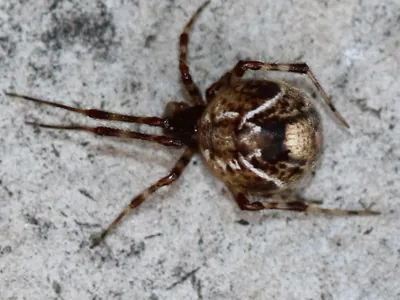
Not sure what spider you have?See our guide to common spiders in Ontario, including the common house spider and the bridge orb weaver.

