Spider identification
If your house is within sight of Lake Huron and the eaves fill with rows of round webs every summer, this is almost certainly the spider. The bridge orb weaver is the single biggest source of webbing and spotting on lakeside homes from Sarnia to Port Elgin.
Grey brown, about 1 cm in the body with legs spanning 2 to 3 cm, banded legs and a pale cross shaped or leaf shaped mark on a flattened abdomen. The web is a classic round orb, often with a gap in the middle, and dozens of them can sit in a row under one run of soffit. By day the spider tucks into a corner, a soffit vent or the gap behind a light fixture; after dark it sits in the hub of the web.
Any lit surface on the outside of the house: under eaves and soffits, around porch and garage lights, on railings, window frames, dock posts and boathouses. It favours the side of the house facing the water and any wall that is lit at night, because the lights draw the midges and mayflies it eats. The dark spotting on light siding and under lights is its droppings.
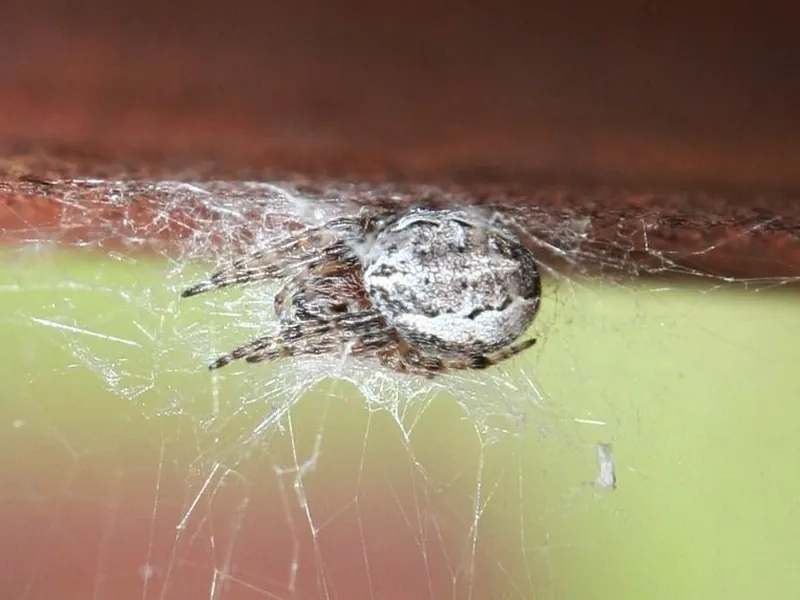
On buildings from late May, heaviest from July to September when lake insects peak, and still active into October. Females lay several egg sacs in cracks and corners through late summer and the spiderlings overwinter in the same sheltered spots, which is why the same corners refill each year.
Not a concern. It runs rather than bites, and a bite would need the spider to be pressed against skin. There are no medically significant effects. Most "spider bites" in Ontario are never confirmed; see the bite section of our guide to common spiders in Ontario for what a real one looks like.
This is the spider most of our work is about. We vacuum the webs, the spiders and the egg sacs off every reachable surface, then sweep the high eaves with a cobweb brush on a pole, so the house is clean the day we leave. Where a corner shows heavy activity and sacs we apply a targeted treatment to that site only. Because the lake keeps supplying food, lakeside homes do best on the Season Plan, which stays ahead of the July to September peak rather than reacting to it. Every visit ends with a written summary of what we found and where product was applied, if any. Our spider control service and 60 day guarantee pages have the details and pricing.
Furrow orb weaver, Common house spider, Cross orb weaver. The furrow orb weaver is a close cousin with a scalloped leaf mark instead of a cross and is often mixed in with it. The common house spider makes tangled cobwebs, not round orbs. The cross orb weaver is larger and sits in a much bigger web in late summer. The full list with photos is in the common spiders in Ontario guide.
Good to know
Lake Huron produces enormous numbers of midges and mayflies, and lights on the house concentrate them against the walls. The bridge orb weaver lives where that food lands, so a lit lakeside wall can carry dozens of webs by July.
Rarely. It is an outdoor spider that lives on the building surface. The spiders you find indoors in fall are usually different species.
No, and we do not claim that. Removal clears the house the day we visit and targeted treatment slows the busiest corners, but the lake keeps supplying food. That is why we offer the three visit Season Plan and a 60 day guarantee on treated areas.
Related guides: When is spider season along Lake Huron, Spiders near Lake Huron in Sarnia and Point Edward, Keeping spiders away from windows, eaves and lights. Service areas where this spider is found: Sarnia and Bright's Grove, Grand Bend, Kincardine, Port Elgin.

