Spider identification
The spider that causes the alarm on the lake. A big female dark fishing spider can span the palm of a hand, and finding one flattened against the boathouse wall or the dock post at dusk is a memorable moment for most cottagers. It is the dock spider of Ontario lore, it is shy, and it is far less dangerous than it looks.
Mottled brown and grey with dark chevrons on the abdomen and dark banded legs, 1.5 to 2.6 cm in the body and up to about 9 cm across the legs in a large female. It sits flat against wood or bark with the legs spread, and it is most often found motionless on a vertical surface. It does not build a web to catch prey; the female carries a large round egg sac in her jaws in June and July and then guards a nursery web of spiderlings in a shrub or under an eave.
Dock posts, boathouse walls, the lake side of cottages, tree trunks, woodpiles and sometimes well away from water in wooded lots. It hunts at night, takes insects and occasionally small fish and tadpoles, and will run across the water surface. It wanders indoors occasionally, usually into a cottage or garage, and is usually reported as a wolf spider.
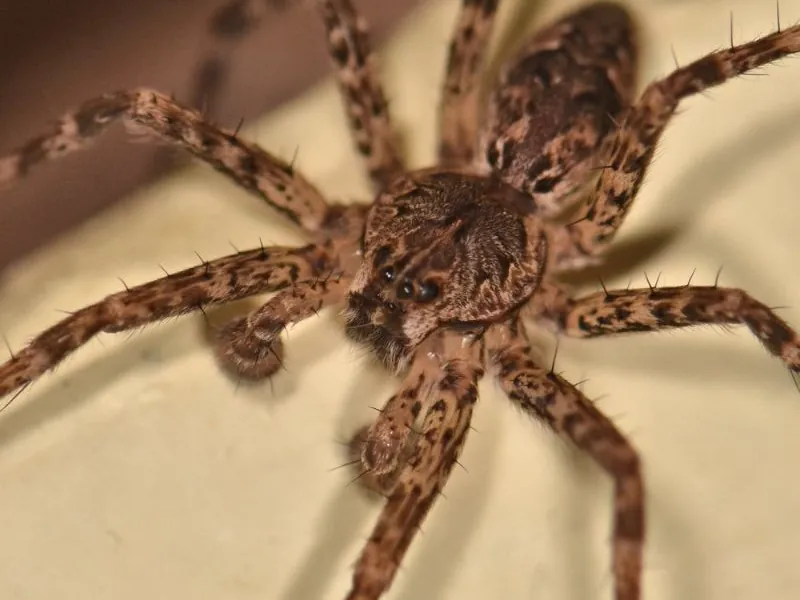
Adults appear from May; females with egg sacs are seen in June and July and nursery webs in July and August. Immature spiders overwinter under bark and in cracks, so a cottage opened in May can already have them.
Only if squeezed or trapped against skin. It has large fangs, and a bite is a brief local pain like a bee sting with no lasting effects. It is not aggressive and will run or drop into the water first. Most "spider bites" in Ontario are never confirmed; see the bite section of our guide to common spiders in Ontario for what a real one looks like.
We do not target fishing spiders with treatment; they are hunters without webs and a residual product on a dock post does nothing useful. When we find one on a cottage or boathouse during a visit we remove it along with any nursery web, and we vacuum the overwintering spots under eaves and in trim corners. If you have one in the house, a jar and a piece of card is the fix. The webbing on cottage eaves and lights is a different group of spiders and that is what the service is for. Every visit ends with a written summary of what we found and where product was applied, if any. Our spider control service and 60 day guarantee pages have the details and pricing.
Wolf spider, Grass spider, Barn funnel weaver. Wolf spiders are smaller, rounder and hunt on the ground; the female carries her egg sac behind her, not in her jaws. Grass spiders sit in sheet webs and have the long spinnerets. The barn funnel weaver is the big brown basement spider in a funnel web. Its cousin the six spotted fishing spider is greenish brown with a white stripe along each side and lives on the water surface rather than on buildings. The full list with photos is in the common spiders in Ontario guide.
Good to know
No. Its size is alarming but a bite is rare and comparable to a bee sting. There are no medically significant fishing spiders in Ontario.
Yes. It hunts on the water surface at night and takes small minnows and tadpoles as well as insects, which is where the name comes from.
That is a fishing spider nursery web. The female guards it for a week or so until the spiderlings disperse. We remove them when we find them on a visit.
Related guides: Spiders near Lake Huron in Sarnia and Point Edward, When is spider season along Lake Huron. Service areas where this spider is found: Grand Bend, Bayfield, Port Elgin, Kincardine.

