Spider identification
The messy, dusty cobweb in the corner of the porch ceiling or the top of the window frame belongs to the common house spider. It is small, it is everywhere, and with the bridge orb weaver it accounts for most of the webbing we vacuum off a house.
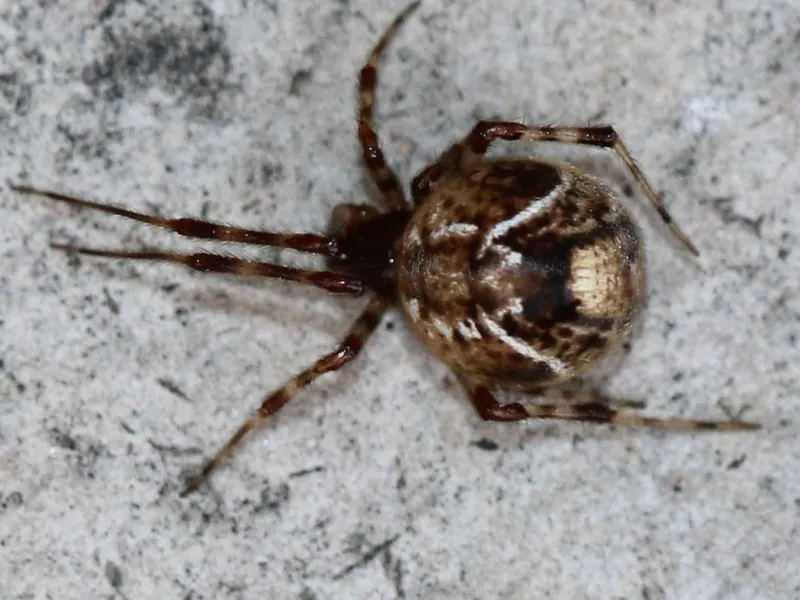
Small and round bodied, 5 to 8 mm, mottled brown and tan with a tall bulbous abdomen and thin banded legs. The web is the tell: an irregular tangle rather than a neat orb, usually with dead insects, debris and one or more small brown papery egg sacs hanging in it. The spider hangs upside down in the tangle or hides in the corner it is built into.
Porch ceilings, the corners of window and door frames, behind shutters, under deck rails, inside garages and sheds, around outdoor lights and in basements and crawl spaces. It likes a corner with two walls and shelter from rain, and it rarely moves once established.
Outdoors from spring to the first hard frosts, indoors all year. Several generations overlap in one season, so new webs appear within days of old ones being cleared and old webs are left standing, which is why a neglected porch looks worse every month.
Very rare and mild. It is timid and drops or runs when disturbed. A bite is a small itchy bump at most. Most "spider bites" in Ontario are never confirmed; see the bite section of our guide to common spiders in Ontario for what a real one looks like.
Vacuuming is exactly the right tool for this spider: the HEPA vacuum takes the tangle, the spider, the debris and the egg sacs in one pass, and nothing is left hanging. We pay particular attention to porch ceilings, window corners and the garage door frame, where it is densest. Where a corner shows repeated rebuilding we treat that site. On its own it rarely justifies a treatment; removal and taking the sacs does most of the work. Every visit ends with a written summary of what we found and where product was applied, if any. Our spider control service and 60 day guarantee pages have the details and pricing.
Bridge orb weaver, False black widow, Long bodied cellar spider. The bridge orb weaver builds a round orb, not a tangle. The false black widow is a darker, glossier relative with the same style of web, usually in a basement or garage. The cellar spider has much longer legs and a loose web in a basement corner. The full list with photos is in the common spiders in Ontario guide.
Good to know
Yes, this is the species most people mean. It lives on the outside of the house all season and in basements, garages and quiet rooms year round.
Knocking a web down leaves the spider and usually the egg sac in the corner. The sac holds dozens of spiderlings. Taking the sac matters more than taking the web, which is why we vacuum rather than brush.
Usually not. Removing the webs and egg sacs and reducing light at night does most of the work. We treat a corner only when removal shows it is rebuilding heavily.
Related guides: Why spider webs keep coming back, Spider web removal versus spraying, The spider life cycle and why timing matters. Service areas where this spider is found: Sarnia and Bright's Grove, Goderich, Bayfield.

