Preparing for your visit

Five minutes of prep. Nobody needs to be home.

Your visit is booked for a service day in your area. Here is what to do before the crew arrives, what happens while they are there, and what to expect in the days after.

Before we arrive

The short checklist

Please do

Give us a clear run at the house

  • Unlock the gate, or text us the code
  • Keep dogs and cats inside, or in a part of the yard we are not working on, until the areas are dry
  • Move patio cushions, barbecue covers and toys a few feet away from the walls
  • Close windows and doors, and shut off ceiling fans on screened porches
  • If you plan to wash siding or windows, do it before the visit; washing afterwards removes the treatment
  • Tell us about a sting allergy in the house, a pond, a vegetable garden against the wall, or a bird feeder we should work around
No need to

Things people worry about that do not matter

  • Be home. Most customers are not. We leave a written summary at the door or by email
  • Knock down the webs yourself. Leave them; that is the job, and the webs show us where the spiders are
  • Cover the garden or the pond. We vacuum first and treat only the house, not the plants or the ground
  • Move the car. We work around it
  • Tip the crew. A review once the season is over is worth far more to us

While we are there

What the visit looks like from the window

  1. The walk aroundThe technician circles the house first, noting where the webs are, where the egg sacs are, and anything you flagged.
  2. RemovalEvery web, spider and egg sac within reach comes off with the backpack vacuum, and the high peaks and eaves are swept down with a brush on a telescoping pole. This is most of the visit.
  3. Targeted treatmentOnly the spots spiders settle: eaves, soffits, window and door frames, the foundation line, around exterior lights. About 20 minutes on a standard home.
  4. The summaryWhat we did, the product name and PCP registration number, where it went, the re-entry time and our exterminator and operator licence numbers, left at the door or sent to you by email.

About the gear

Why the technician is dressed like that

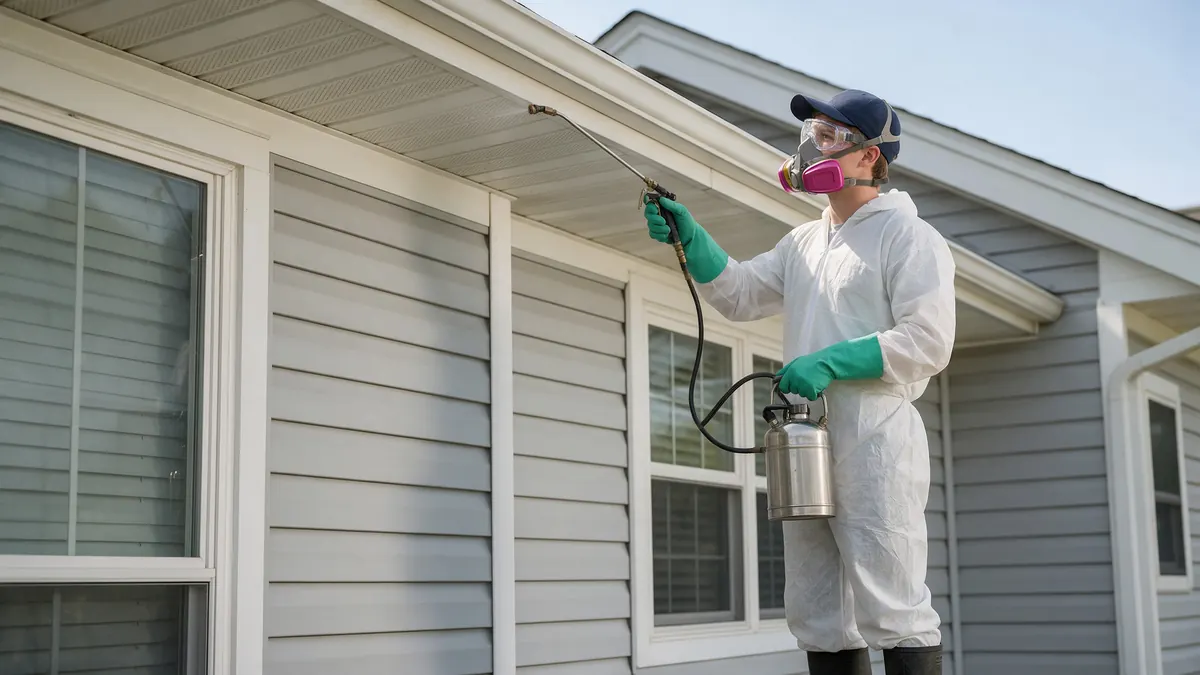
Spider Pros technician in a respirator, eye protection, chemical resistant gloves and coveralls treating the eaves overhead

The product label requires long sleeves, long pants, chemical resistant gloves and eye protection for overhead work. We add a respirator for anything applied overhead as company policy, because the technician's face is a foot from the eaves. So that is what you will see, every time, even on a hot day in July. The label also sets the re-entry time for everyone else, and that is the time on your summary.

For the vacuuming, which is most of the visit, the technician wears ordinary work clothes, because nothing is being applied.

After we leave

The next few days

Until it is dryKeep people and pets off treated surfaces until the time on your summary. Once it has dried, an ordinary rain does not remove it.
The first weekYou may see a few spiders on the ground or on the siding in the first week. That is normal after a treatment.
Weeks two to eightA few new webs by the porch and garage lights after a lake hatch are normal and the plan expects them. If treated areas are building up again inside 60 days, tell us and we come back. The guarantee.

Questions before your visit? Call or text 519 331 4210. Book my visit