Homeowner guide
The spider life cycle decides when spider control works and when it is wasted. The spiders that cover a Sarnia or Kincardine house in September are mostly gone by November, but what they leave behind is next summer's population. Understand the cycle and the three visit season makes sense; ignore it and you end up spraying a house that is already empty.
Most of the webs people notice on homes between Sarnia and Port Elgin belong to three groups. Orb weavers build the big round webs across porch lights, window corners and the gap between the soffit and the eavestrough; the bridge orb weaver (grey cross spider) is the one you see in rows under lakeside eaves and on lit siding. House spiders build the small tangled cobwebs in corners, under railings and around door frames, and they stay close to the structure all year. Funnel weavers build the flat sheet webs with a tunnel at the back, in the siding seams, the foundation line and the grass along the walls.
Wolf spiders and jumping spiders are around too, but they hunt rather than build, so they rarely cause the visible mess. The webs are the problem, and the web builders are the ones the cycle below describes.
Orb weaver eggs spend the winter in silk sacs tucked into soffit corners, behind shutters, under sills and in the top of the garage door frame. When the first stretch of warm weather arrives, usually the first half of May here, the sacs hatch. A single sac holds dozens to a few hundred spiderlings. They climb to a high point, release a strand of silk and let the wind carry them, which is why a house that was clean in April can have tiny webs everywhere by the May long weekend.
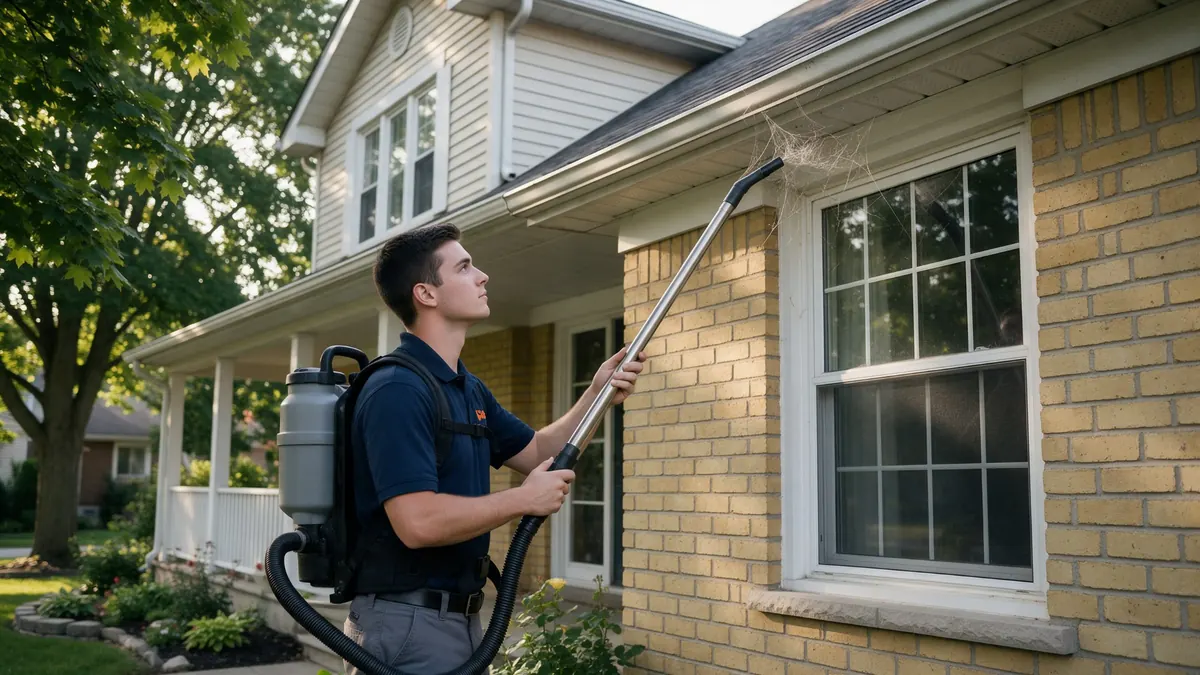
This is the first reason timing matters. Every sac removed before it hatches is dozens of spiderlings that never start on your house. A May visit that takes the overwintered sacs off the house with the vacuum does more for the summer than any treatment, because there is nothing yet to treat.
From late May through July, midges and mayflies hatch off the lake in the evening and fly inland toward light. They do not stop at the beach; they reach porch lights and garage lights several kilometres from the water. The spiderlings that settled in May grow fast on that supply, and the biggest webs of the year go up where the light and the food meet.
This is when a targeted treatment earns its place, if it is going to. Spiders are settled in specific spots, the surfaces are dry and warm so a registered product holds, and the hot spots are obvious: the light fixtures, the corners of the frames on the lake side, the soffit run over the garage. Product on those sites, after the webs are off, reduces the number that survive to breed. Product on every wall of the house does nothing extra and puts more of it around the garden and the dog.
By late August the orb weavers are full size, which is why September is when people call in alarm. The females are at their largest, the webs are at their biggest, and the egg sacs are being laid. Each female lays one or more sacs in a sheltered spot on the structure, then dies at the first hard frost in October or November.
This is the second reason timing matters. A September visit that removes the adults and, more importantly, the fresh sacs is a direct cut to next May's hatch. Spraying in September kills adults that have weeks to live anyway; removing sacs removes the generation that would be on the house next year.
Not everything dies. House spiders and funnel weavers shelter in the siding seams, under the deck ledger, in the garage and behind anything stored against the walls, and some keep laying through the cold months in warmer corners. They are why a few new cobwebs appear around the door in March before anything has hatched outdoors.
A fall visit, where the house gets one, is mainly a cleanup of old webs and sacs in dry weather. Spraying cold wet siding in November is poor practice: the label limits it, the product does not hold, and there is almost nothing moving to treat.
The Spider Pros Season Plan is three visits for a reason: May to take the overwintered sacs and the first spiderlings, July to clear the summer build up and treat the hot spots while they are active, and September to take the adults and the new sacs before they are tucked away for winter. Each visit starts with removal, because that is what works on sacs, and treatment is kept to the places where spiders are living. Our spider control page explains the visit, and the month by month guide covers what you will see between visits.
For a single visit, the same logic applies: May and September do the most lasting good; July does the most visible good. Tell us which matters more to you and we will say which to book. Homeowners in Sarnia and Bright's Grove, where the south route starts, usually get the earliest May dates.
Good to know
Because the egg sacs do not die. The adults you see in September are laying the sacs that hatch in May. Removing the sacs now is one of the most useful things that can be done for next summer, and it is a removal job, not a spray job.
Removal in April is useful; treatment usually is not. Surfaces are cold and often wet, the label restricts application, and there is nothing settled on the house yet for a residual to work on. We would rather vacuum the sacs off in late April or May and treat in July where it is needed.
Because the hatch off the lake does not stop. New spiderlings balloon in on the wind and settle near the lights. A few new webs after a July visit are new arrivals, not a failed visit, and the Season Plan is built around them. The guarantee covers the areas we treated for 60 days.
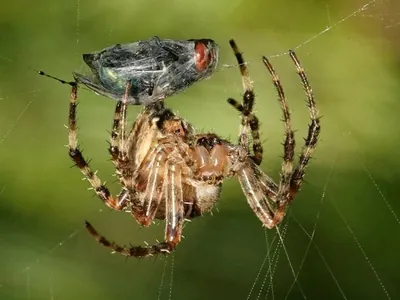
Not sure what spider you have?See our guide to common spiders in Ontario, including the cross orb weaver and the grass spider.

