Sarnia
You knock the web off the porch light on Saturday and by Wednesday it is back. If your spider webs keep coming back in the same corners, the cleaning did not fail. The corner is still a good place to hunt, and in Sarnia the hunting is very good.
A web is a tool. A spider builds one where insects pass and where there are solid points to anchor the silk. Knock the web down and the insects still pass that spot tomorrow night. Either the same spider rebuilds, often overnight, or another one moves in from the hedge within a week or two.
Removing a web changes what is on the wall today. It does not change why that wall was chosen. That is the whole puzzle, and it is why the answer is a routine rather than a single heroic clean.
Sarnia and Bright's Grove sit at the south end of Lake Huron, beside the mouth of the St. Clair River. Midges, mayflies, caddisflies and the rest hatch over that water in enormous numbers through spring and summer. After dark they drift inland and gather at whatever is lit. A house two or five kilometres from the water gets its share every night, because the porch light is the brightest thing on the street.
So the spots that fill up fastest are the lit ones: the fixture beside the front door, the window with the kitchen light behind it, the garage lights, the patio door. Then the sheltered ones: porch ceilings, soffit corners, the top of the garage door frame, behind the downspout. Those two lists overlap on almost every house, and that overlap is where the webs come back.
It helps to tell old cobwebs from fresh webs. A dusty, sagging cobweb in a sheltered corner may have been abandoned months ago. A clean, orderly web with a spider sitting in it or tucked beside it is current activity. Both look bad and both should come off the house, but repeated fresh webs in one place tell you the insect supply and the anchor points are still there, and that spot deserves closer attention.
A few photos of the three or four worst corners, taken every week or so, will show you the pattern faster than memory will.
Rain and a quick hose down knock loose webs off the siding and leave the soffit corners, recessed trim and the inside of the porch ceiling untouched. Those are the places the spiders prefer, so the rebuild starts from the spots the water never reached. The egg sacs stay too. Forcing water up into light fixtures, outlets and eaves to chase the corners creates problems of its own.
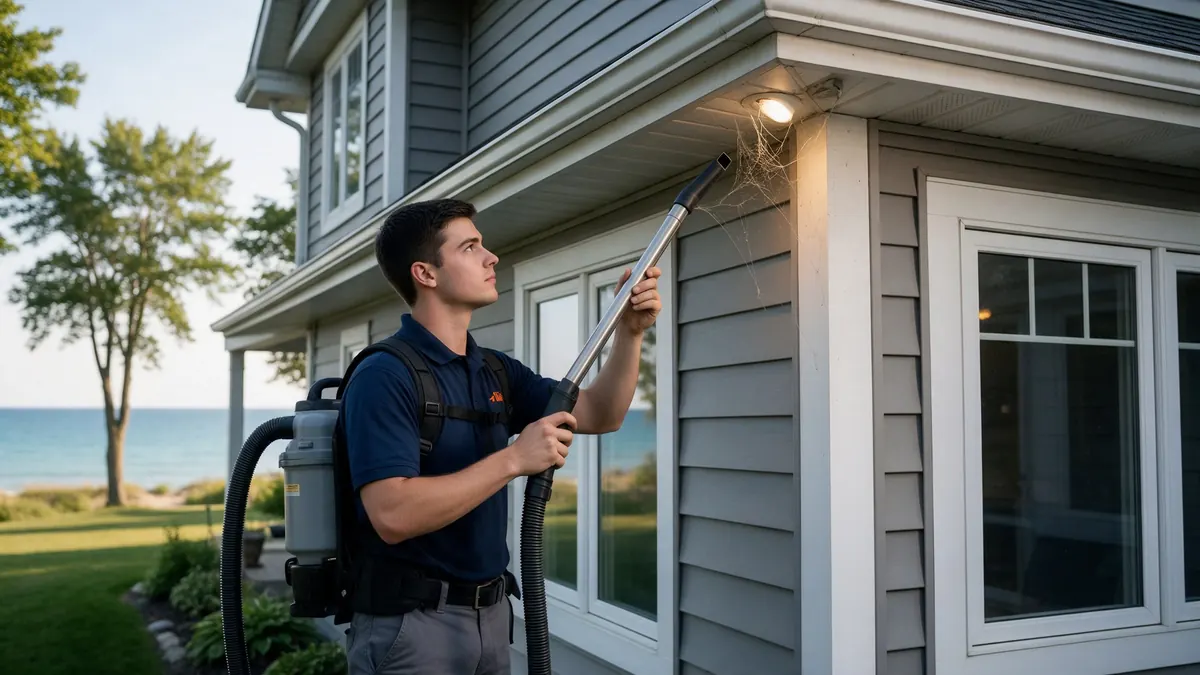
A deliberate removal pass is different. A backpack HEPA vacuum takes the webs, the spiders and the egg sacs off everything within reach: porch ceilings, lights, window and door frames, garage door frames, first floor soffits and the foundation line. High eaves and peaks get a cobweb brush on a telescoping pole. Nothing is left behind to hatch, and nothing washes off because nothing was applied. That is the first step of every Spider Pros visit.
None of this makes a house spider proof. Together, these steps mean fewer spiders choose your walls and the ones that do have less to eat.
Usually not on its own, and never first. Product does not take old webs down, and a wall sprayed every month does not stay web free in a town where new insects arrive every night. Spraying every wall of every house on a schedule also puts more product around dogs, gardens, pollinators and the lake.
Where one corner keeps refilling after removal, a targeted treatment can be justified. A Spider Pros technician uses a product registered in Canada, applies it only to the sites the label allows, at the lowest label rate that works, wearing what the label requires: long sleeves, long pants, chemical resistant gloves, and eye protection for overhead work, plus a respirator for overhead work as company policy. You get a written summary saying what was used and when the area is clear, and people and pets stay off it until then.
If webs come back on the areas we treated in the 60 days after a visit, we treat them again the next day we are in your area at no charge. The guarantee page has the details.
After a good removal, photograph the same three or four problem spots. Check them again over the next two weeks and note which lights were on, what the weather did and whether any bushes touch the wall. If the lit spots refill and the dark ones stay clean, you have your answer about the lighting. If one sheltered corner refills no matter what, that is the corner worth treating.
Spider Pros runs a regular route through Sarnia, Bright's Grove and Point Edward, so the follow up visit lands when the corners actually need it. See the Sarnia page for how the route works in your area, or call 519 331 4210.
Good to know
Some orb weavers rebuild overnight. Others take a few days, and a sheltered corner may sit empty for a couple of weeks before a new spider finds it. The timing varies; the pattern of where it comes back is what matters.
The lake and river supply the insects, but the porch light is what brings them to your house. A lit subdivision home three kilometres inland often has more webs than a dark house on the river. Lighting and sheltered corners usually matter more than the distance.
No. HEPA describes the filter, which holds the fine dust and silk so it does not blow back out. The vacuum removes what is there, including egg sacs, which keeps the numbers down. It does not stop a new spider arriving.
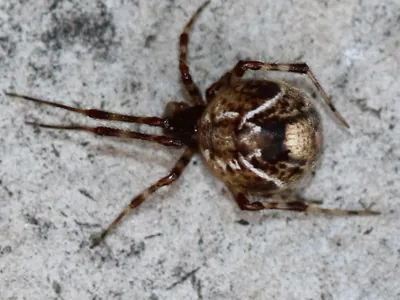
Not sure what spider you have?See our guide to common spiders in Ontario, including the common house spider and the bridge orb weaver.

