Homeowner guide
The webs are never spread evenly over a house. They cluster around the porch light, the corners of the front windows and the soffit above the garage, because those are the places where light, shelter and insects meet. If you want to keep spiders away from windows and outdoor lights, the work is in changing those three things, not in spraying the whole wall. Here is how to do it.

A spider needs two things: food and a place to anchor a web out of the wind. On a home anywhere along Lake Huron, from Goderich to Sarnia, the food arrives every night from the lake. Midges, mayflies and caddisflies hatch off the water and fly inland to the brightest point they can find, which is your porch light, the fixtures on the garage or the lit window of the living room. The anchor points are everywhere nearby: window frames, door frames, soffits, porch ceilings and the lip of the garage door, all sheltered from rain and wind.
Put a light beside a sheltered frame and you have built the best spider site on the street. That is why the same window fills in every week and the one around the corner, with no light near it, stays clear. It is also why a house in a Goderich subdivision off Highway 21 can carry more webs than one closer to the water. Lighting and shelter matter more than distance.
The single most effective change a homeowner can make costs under fifty dollars. Put the porch and garage lights on a motion sensor or a timer so they are off through the hours when the insects are flying. A light that runs dusk to dawn feeds spiders all night; one that comes on when someone walks up feeds them for a few minutes.
If the fixture must stay on, point it down and shield it so it lights the step rather than the sky, and consider a warmer coloured bulb. Warm and amber light attracts fewer flying insects than cool white, though no bulb keeps spiders away on its own. Treat it as a reduction, not a fix.
Lit windows work like lights too. Blinds drawn after dark on the rooms facing the street cut the glow that pulls insects to the glass.
Removal is where the house changes the most. A web knocked off with a broom is back in a day if the spider is still there, and the egg sac tucked in the corner, a small white or tan bundle, hatches dozens more into the same spot. On the porch and the first floor, a household vacuum with a crevice tool does the job: along the top of every window and door frame, around the light fixture and its mounting plate, under the soffit lip above the garage, and along the foundation line where the siding meets the wall.
High eaves and the peaks of a two storey home are a different matter. Do not go up a ladder against the siding for a web, and keep any pole or brush well away from the service line where it enters the house; electricity can arc across a gap. Those areas are what a professional's cobweb brush on a telescoping pole is for.
Pressure washers are a poor tool for this. The water goes behind siding and into light fixtures, and it still leaves the sac behind.
A few habits take away the shelter half of the equation.
High eaves, a heavy buildup that has been there since spring, or a corner that refills no matter what you change: those are the reasons to call. Every Spider Pros visit starts with removal. A backpack HEPA vacuum takes webs, spiders and egg sacs off everything within reach, including porch ceilings, lights, window and door frames, the garage door frame, first floor soffits and the foundation line. High eaves and peaks are swept down with the cobweb brush on the pole. Removal works instantly and does not wash off.
Then, only where activity justifies it, a targeted treatment goes on those sites. The product is registered in Canada and applied where the label allows, at the lowest label rate that works, by a trained technician, supervised by our licensed exterminator, wearing what the label requires: long sleeves, long pants, chemical resistant gloves, and eye protection for overhead work, plus a respirator for overhead work as company policy. In Goderich that also means checking the wind at each wall; nobody sprays in a gust off the lake. People and pets stay off treated areas until dry, with the time in writing, and a written summary after every visit says what was used and when each area is clear.
We do not spray every wall of every house every month. Product applied everywhere, every time, puts far more of it around pets, gardens, pollinators and the lake than the job needs, and still leaves every web hanging. Treating the handful of sites that earned it keeps ahead of the spiders with far less. A single visit is from $199 and the three visit Season Plan, May, July and September, is from $499, before HST for a standard home, confirmed before work starts. The service is described on the spider control page, route details for the area are on the Goderich page, and the 60 day re-treatment guarantee is on the guarantee page.
Spring: change the lights, trim the shrubs, and take down last year's webs and sacs before the first warm week. Early summer: check screens and the corners nearest the lights as the June hatch arrives. Late summer: the orb weavers are full grown and their webs are the ones you notice, so a thorough removal now also takes the sacs that would hatch next spring. Fall: clear the entrances, check the door sweeps and the garage seal, and the house is ready for winter.
Good to know
They reduce the number of insects that come to the light, which reduces the spiders that set up beside it. They do not stop either. A motion sensor does more than any bulb, because the light is simply off for most of the night.
If the spider and egg sac go with it, that corner stays clear far longer than a web brushed off with the spider left behind. If a light is still running all night beside it, a new spider will find it eventually. Change the light and remove properly, and most corners stay quiet.
That is how every visit works. Removal first, everywhere within reach and on the high eaves, then a targeted treatment only on the sites where activity justified it. The written summary lists every treated site, and on many homes it is a short list.
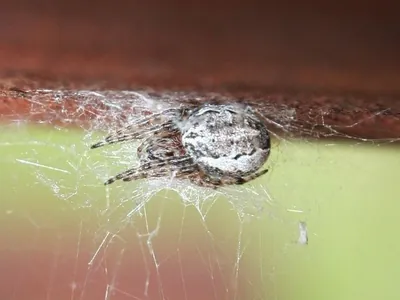
Not sure what spider you have?See our guide to common spiders in Ontario, including the bridge orb weaver and the barn orb weaver.

