Grand Bend
Most of the homes that need spider control in Grand Bend are nowhere near the sand. They are on the streets behind the main strip, in the subdivisions along Highway 21 and in the year round neighbourhoods of Lambton Shores, and they get the same evening traffic of lake insects as anywhere closer to the water. This guide explains why the webs build so fast here, what you can change yourself, and what a proper visit looks like.
Lake Huron produces insects by the million. Midges, mayflies and caddisflies hatch off the water from late spring through summer, and after dark they move inland. Two, five, even several more kilometres from the shore, they end up at the porch light and the fixtures over the garage. Spiders follow the food and set up a web beside every light.
Grand Bend adds its own factor: trees. Pine and mature hardwoods close to the house are everywhere in Lambton Shores. They hold insects, and they shade one side of the house so it stays cool and damp. The shaded side of a Grand Bend home almost always carries more webs than the sunny side. Add the shelter of soffits, porch ceilings and window frames, and you have a house spiders like.
Brushing a web off changes nothing about the corner. The light still draws insects, the frame still blocks the wind, and the spider, if it was not removed with the web, rebuilds overnight. Even when the spider goes, the egg sac usually stays. Those small white or tan bundles tucked into the corners hatch dozens of spiderlings into the same sheltered spot. Clearing webs without clearing sacs is how a house gets worse through the summer.
For the homes and seasonal properties in Grand Bend that sit empty for stretches, this compounds. Nobody is knocking the webs down, so by the time anyone arrives the porch has a month of buildup on it. The answer is the same either way: remove everything together, change what you can, and keep ahead of it on a schedule.
Spraying a web does not remove the web. It does not remove the egg sac either. And product on every wall of every house every month puts far more of it around pets, gardens, pollinators and the lake than the job needs, and still leaves every web hanging. That is why Spider Pros works in a different order.
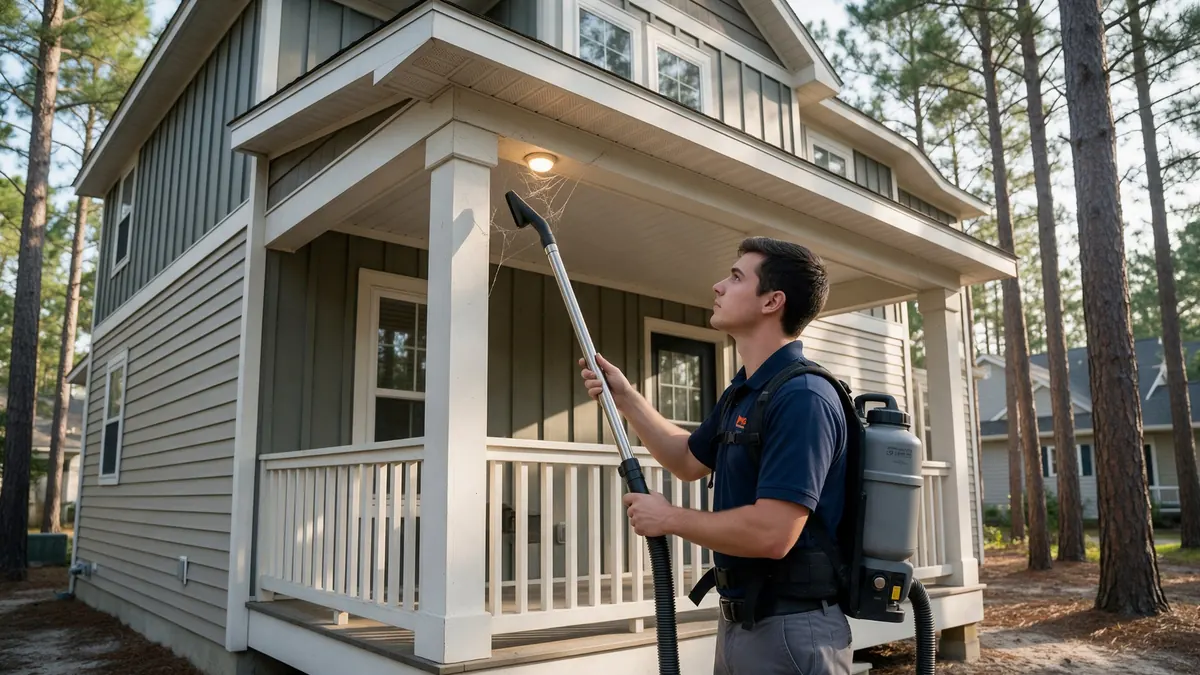
Every visit starts with removal. A backpack HEPA vacuum takes the webs, spiders and egg sacs off everything within reach: porch ceilings, lights, window and door frames, the garage door frame, first floor soffits and the foundation line. High eaves and peaks are swept down with a cobweb brush on a telescoping pole. Removal works instantly and does not wash off in the next storm.
Then, only where activity justifies it, a targeted treatment goes on those sites. The product is registered in Canada, applied where the label allows at the lowest label rate that works, by a trained technician, supervised by our licensed exterminator, wearing what the label requires: long sleeves, long pants, chemical resistant gloves, and eye protection for overhead work, plus a respirator for overhead work as company policy. People and pets stay off treated areas until they are dry, and that time is written down. After every visit you get a written summary of what was used and when each area is clear. For a house nobody is at, the summary includes photos, so you can see the work was done.
Grand Bend is on the Sarnia route, usually on the same service day as Forest and Thedford, and the roads around the Pinery and Port Franks are covered too. A single visit is from $199. The Season Plan is three visits, May, July and September, from $499. Larger homes run about 30 percent more. All prices are before HST, for a standard home up to about 2,000 square feet, and confirmed before work starts. Wasp and hornet nests are a separate service from $199. The service is described in full on the spider control page, and route notes for the area are on the Grand Bend page.
The guarantee is simple. If webs come back within 60 days on the areas we treated, we re-treat them the next day we are in your area at no charge. It covers the house itself. Decks, railings, fences and the yard are courtesy areas: we clear them, but sun and foot traffic wear anything off a deck board in days, so we do not promise what we cannot deliver. The guarantee page spells it out.
The first warm week of May brings the overwintered spiders out, which is why the first visit here is usually early to mid May. June brings the big hatch off the lake and the fastest buildup on lights and porches. July and August keep it going. By late August the orb weavers are full grown and their webs span whole windows, which is when most calls come in. October cools things down.
Most spiders on a Grand Bend house are harmless and useful: house spiders, cellar spiders, wolf spiders and orb weavers, all eating the insects that would otherwise be in your kitchen. Do not handle one you cannot identify, and get a bite looked at if it swells or you feel unwell. For nearly everyone, the problem is the webs.
Good to know
The light brings in the lake insects after dark and the porch ceiling shelters the web from wind and rain. It is the best spot on the house from a spider's point of view. A motion sensor on that light and a proper removal of the web and sac make a difference you can see immediately.
Yes. Give us the access details and the week you want it done, and we fit it into the first Grand Bend service day in that window. You get a written and photo summary so you know what was done before you pull in.
We clear webs off decks and railings as a courtesy and treat only where the label allows and activity justifies it, which on a deck is rarely. Any treated area is noted in writing with the time it is dry, and people and pets stay off it until then.
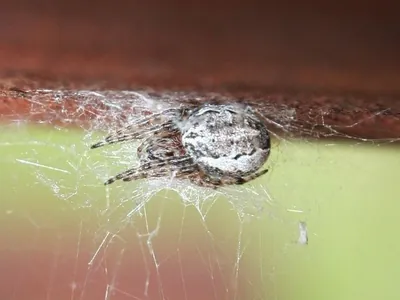
Not sure what spider you have?See our guide to common spiders in Ontario, including the bridge orb weaver and the barn orb weaver.

