Sarnia
Do you need to spray for spiders, or will taking the webs down be enough? For most Sarnia homes the honest answer is: less spraying than you have been told, and none at all until the webs and egg sacs are gone. Here is how Spider Pros decides, corner by corner, and why we would rather under treat than over treat.
Most calls we get are about appearance. Webs across the porch ceiling, silk on the window frames, a big orb web over the garage door, egg sacs in the soffit corners. That is a removal problem. No product takes a web down, and a sprayed web is still a web with a dead spider in it.
A smaller number of calls are about the same corner refilling every few days no matter how often someone brushes it. That is a food and shelter problem, and it can be a treatment problem, but only in that corner. Almost nobody actually needs the whole house sprayed. The decision should follow the inspection, not come before it.
Every Spider Pros visit starts the same way. A backpack HEPA vacuum takes webs, spiders and egg sacs off everything within reach: porch ceilings, lights, window and door frames, garage door frames, first floor soffits and the foundation line. High eaves and peaks are swept down with a cobweb brush on a telescoping pole.
Removal works instantly and it does not wash off in the next rain. Taking the egg sacs with the webs is what keeps the numbers down over the following weeks, since each sac is dozens of spiderlings waiting on warm weather. For a large share of Sarnia homes, this step plus a change to the porch lighting is the whole job. Our spider control page describes the full visit.
Sometimes, in specific places. A porch light on the lake side of the house that fills with fresh silk every three nights. A soffit run over the garage that never clears. A foundation corner where the ground spiders keep moving in from the mulch. Where the activity justifies it, the technician applies a targeted treatment to those sites.
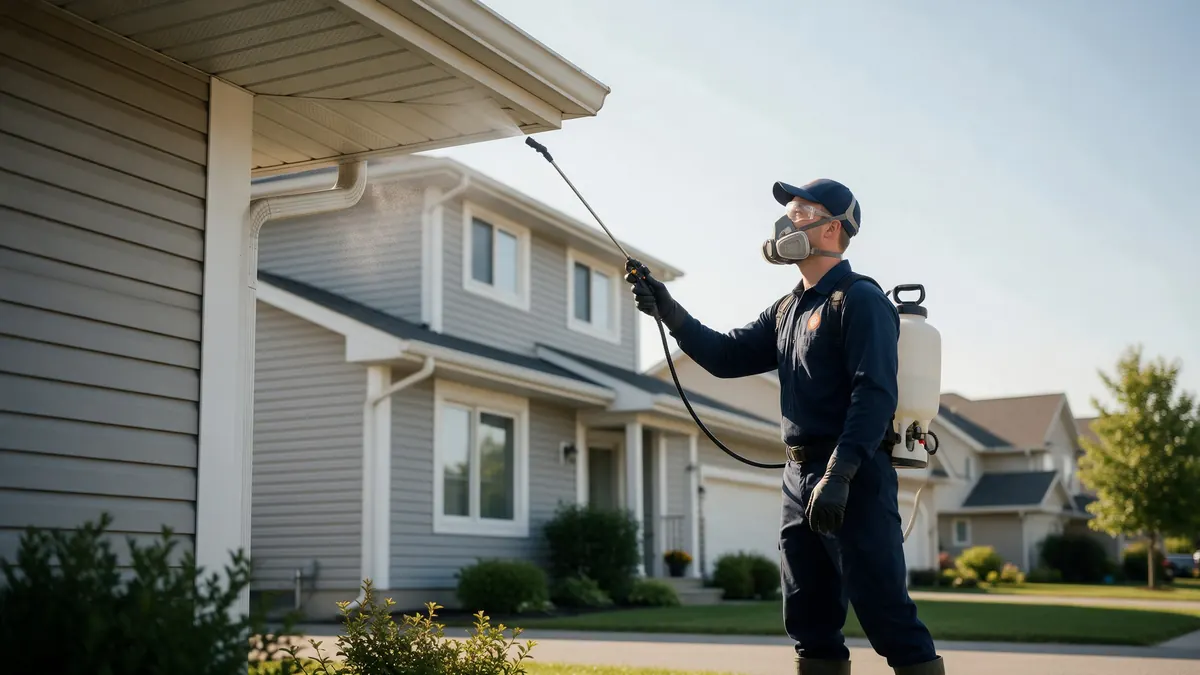
That means a product registered in Canada, applied only to the sites the label allows, at the lowest label rate that works. The technician works supervised by our licensed exterminator and wears what the label requires: long sleeves, long pants, chemical resistant gloves, and eye protection for overhead work, plus a respirator for overhead work as company policy. Any applicator should be able to tell you what product, which label sites, and the re-entry time, and should be dressed the way the label says.
After the visit you get a written summary that says what was used, where, and when the treated areas are clear. People and pets stay off those areas until then. If nothing was applied, the summary says that too, and you will know your house did not need it.
Some companies put product on every wall of every house every month. It is easy to sell because it sounds thorough. It is a poor idea for three reasons.
First, it wastes product and money. Blanket spraying a street every month puts product on hundreds of square metres of siding that have nothing on them, and charges the homeowner for it. Second, product on surfaces that did not need it is product around your dog on the deck, the tomatoes along the fence, the bees in the neighbour's garden and, in Sarnia, the St. Clair River at the end of every storm drain. Third, it does not take a single web down, so the house still looks the same the day after.
Removal first and treatment only where it is earned uses less product, costs you no more, and keeps the product for the corners that need it. That is better for your family, your neighbours and the lake, and using the least product that does the job is simply good practice in our trade.
Ask any applicator, including ours, three things: what product, which sites on the label, and how long until the area is dry. A plain answer to all three is the mark of someone following the label. Be wary of words like natural or low odour used as reassurance; they describe the product, not whether it belongs on your wall.
Keep the dog inside during the visit and off treated areas until the time in your summary. Pull cushions and barbecue covers away from the walls beforehand so nothing is treated by accident. Mention the vegetable bed and the bee balm when booking so the technician knows what is near which corner. None of this is complicated. It is just the label, respected.
A single visit starts from $199 and the Season Plan, three visits in May, July and September, from $499, both before HST for a standard home up to about 2,000 square feet and confirmed before work starts. If webs come back on the areas we treated in the 60 days after a visit, we treat them again the next day we are in your area at no charge. The guarantee page explains what that covers. For service days in Sarnia, Bright's Grove and Point Edward, see the Sarnia page or call 519 331 4210.
Good to know
No. Product leaves the webs, the silk and the egg sacs exactly where they were. That is why removal has to come first, and why a company that only sprays leaves your house looking the same as before.
For many Sarnia homes, yes, especially once the porch lights are on a sensor. For a house with a corner that refills every few days, a targeted treatment in that corner is worth it. The inspection decides, not a sales script.
No treatment can promise that in a town where lake insects arrive at the lights every night. A treated corner stays quieter for a while, the length varies, and the Season Plan exists because three visits keep ahead of the season in a way one cannot.
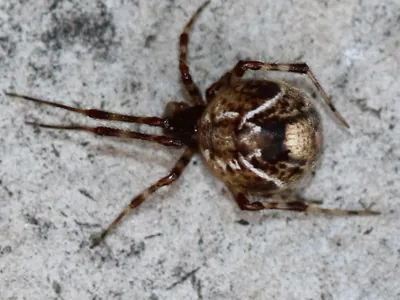
Not sure what spider you have?See our guide to common spiders in Ontario, including the common house spider and the bold jumping spider.

